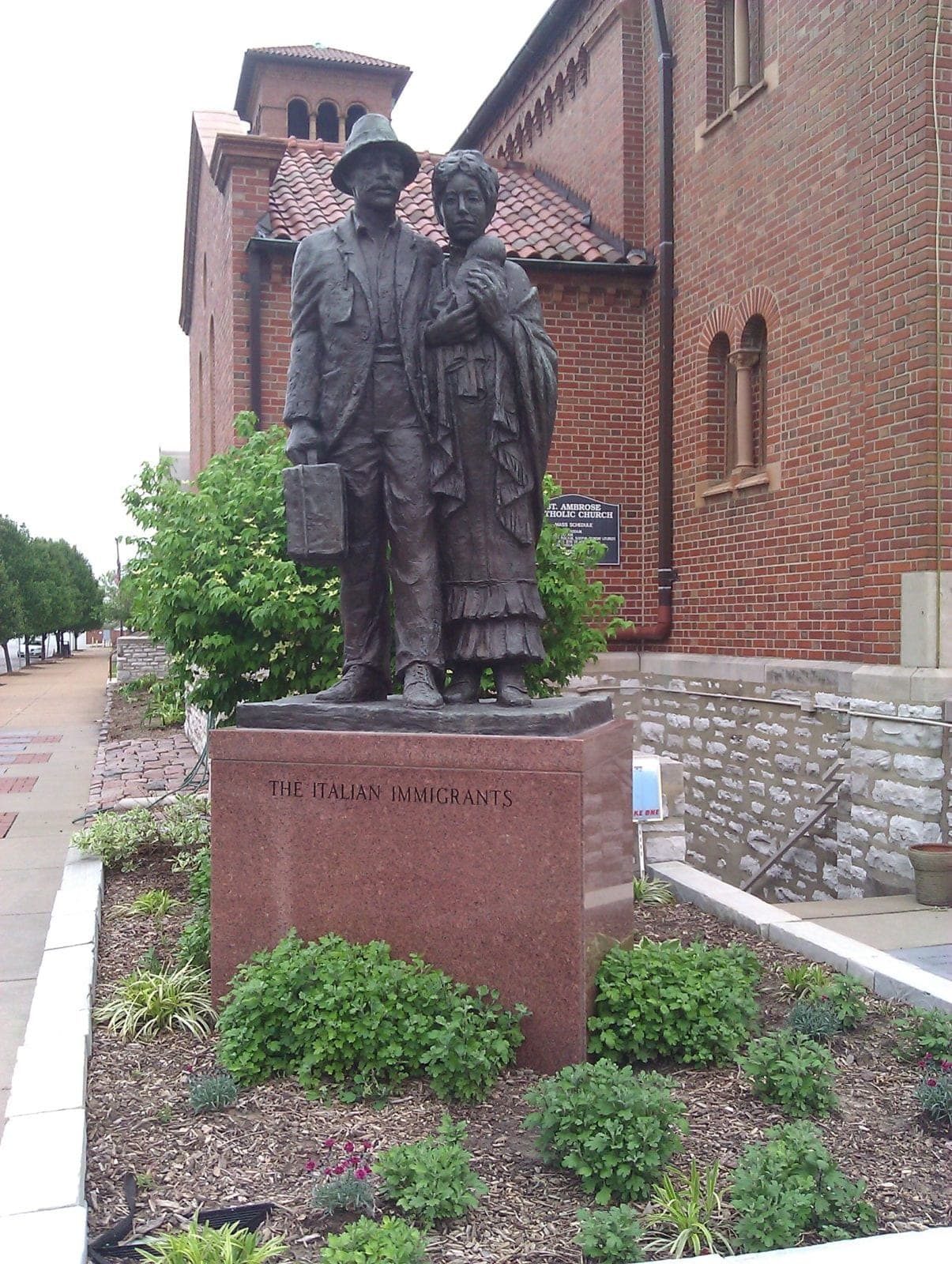
Of all the landmarks on The Hill, few say more about the neighborhood’s origins than a bronze family of three. The Italian Immigrants, a statue by St. Louis sculptor Rudolph Torrini, has represented the Italian settlers who built this corner of south St. Louis since 1972.
What the statue shows
The Regional Arts Commission’s public art inventory describes the piece as a bronze statue measuring roughly 7 feet tall by 3 feet wide and 3 feet deep. It depicts a young immigrant couple dressed in the clothing of the turn of the twentieth century. The mother cradles a newborn and looks downward, as if, in the commission’s reading, already weighed down by the hardships the family had faced. The father carries a single suitcase, steps forward with one foot and looks off into the distance, toward the new life ahead.
The image of a family arriving with little more than a suitcase echoes the neighborhood’s own beginnings, which are covered in our article on the clay mines and the immigrant origins of The Hill.
Who owns it, and when it was dedicated
According to the Regional Arts Commission, the statue was completed in 1972, and it was both donated by and is owned by the Hill 2000 Association, the neighborhood organization. A memorial database maintained by Duke University also lists 1972 as the year of dedication and names the Hill 2000 Association as the owner.
Where to find it
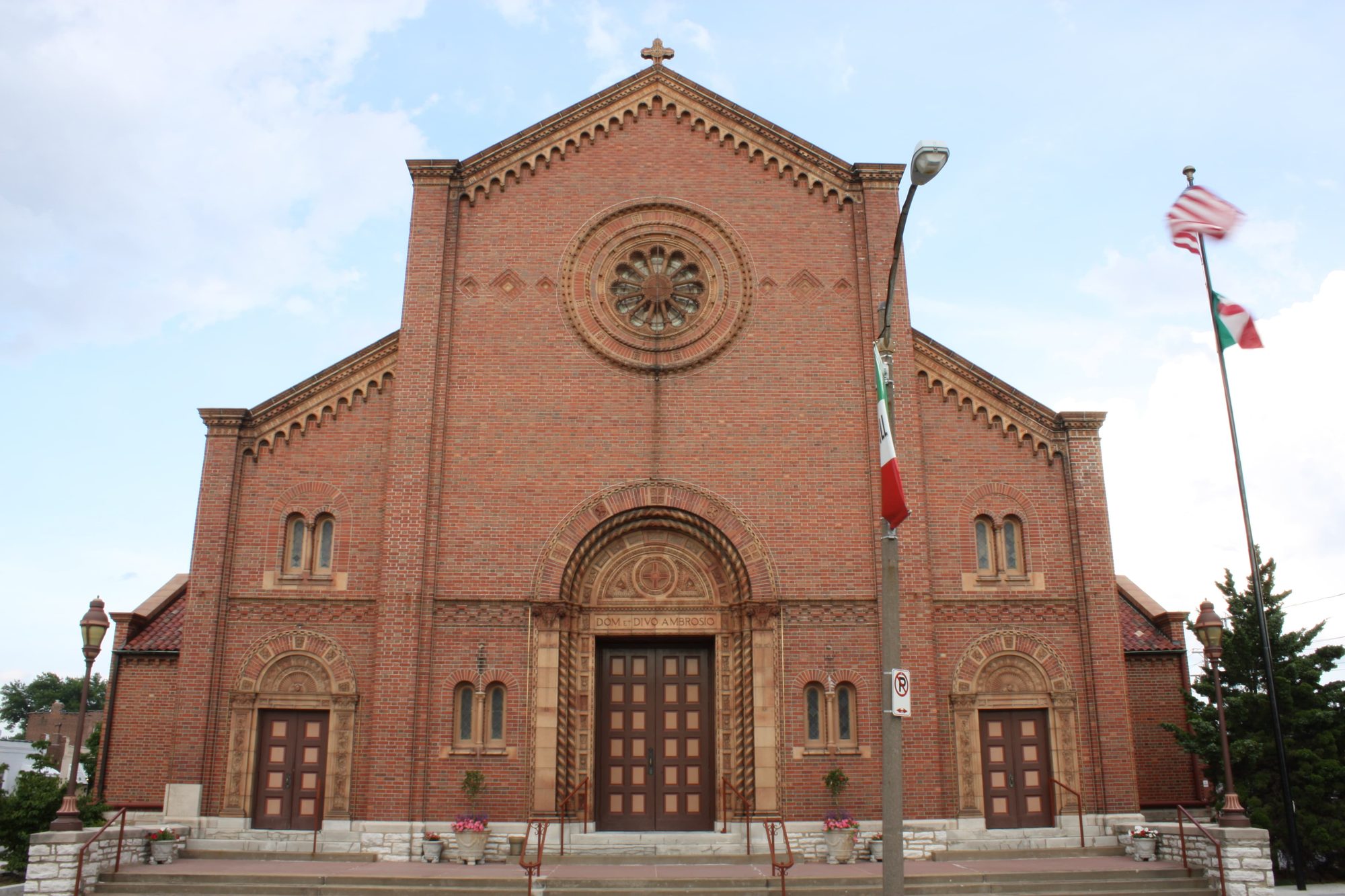
Published sources do not agree on the statue’s address. The Regional Arts Commission’s listing places it at Sublette Avenue at Magnolia Avenue. Other sources put it beside the neighborhood’s landmark church: Duke’s memorial database locates it at the corner of Marconi Street and Wilson Avenue, next to the Catholic church; a 2012 profile of Torrini in the Webster-Kirkwood Times said it stands in front of St. Ambrose Catholic Church; and a 2026 article in The STL pictured the statue outside St. Ambrose. Taken together, the more recent accounts place the statue at St. Ambrose, near Marconi and Wilson. For more on the church, see our history of St. Ambrose.
About the sculptor
Rudolph Edward Torrini was born in St. Louis. His father, Cherinto Torrini, was a plaster former who came to America from the Garfagnana area of Italy, according to the Italian foundry Fonderia Artistica Marinelli. Sources differ on Torrini’s birth year: the Regional Arts Commission and the Marinelli foundry give 1927, while Wikipedia gives 1923, which matches a 2018 tribute reporting that he died at age 95.
The Webster-Kirkwood Times reported that Torrini found his talent for sculpture while serving in the U.S. Navy during World War II and afterward earned a fine arts degree from Washington University. In 1949, according to the Marinelli foundry, a scholarship took him to study at the Academy of Fine Arts in Florence. Wikipedia adds that he earned a master’s degree at the University of Notre Dame, where he studied with the Croatian sculptor Ivan Meštrović.
Torrini spent most of his career teaching. He taught at Webster College for 17 years and then moved to Fontbonne College in 1968, where he stayed for about 35 years, the Webster-Kirkwood Times reported. He mentored Bob Cassilly, who later founded City Museum, according to Wikipedia. Torrini was also a jazz musician who played clarinet and soprano saxophone.
His other public works in the St. Louis area include an 11-foot bronze of Martin Luther King in Fountain Park (1978), the St. Louis Police Memorial (1988) and a statue of Pope John Paul II at the Cathedral Basilica of Saint Louis, according to Wikipedia. Torrini died on September 5, 2018, at age 95, according to a tribute published by the Adorers of the Blood of Christ.
Visiting
The statue is outdoors and can be seen at any time. A visit pairs easily with St. Ambrose and with Piazza Imo, the Italian-style plaza dedicated across from the church in 2019.
For more on the neighborhood’s past, see our History of The Hill timeline.
Sources: Regional Arts Commission, Duke University Migration Memorials, Webster-Kirkwood Times, The STL, Fonderia Artistica Marinelli, Adorers of the Blood of Christ, Wikipedia, MetroSTL