
The History of The Hill
How a community of Italian immigrants built one of America’s best-known Little Italys on a rise of clay above St. Louis.
Clay, brick and a new start
Long before it was known for pasta and bocce, The Hill was known for what lay underground. Deposits of fire clay drew German and Irish workers to this high ground southwest of downtown St. Louis before the Civil War, and in the 1850s firms such as Evens and Howard and Laclede-Christy began mining clay and firing brick. More than a dozen brick and tile works eventually lined the River des Peres nearby.
Beginning in the 1880s, Italian immigrants arrived to work the mines and kilns. The first came from farming villages in Lombardy, many from the area around Cuggiono west of Milan; Sicilians followed later. Many men came alone, lived in boarding houses and sent for their families once they had saved enough. By the early 1920s Italians were the neighborhood's largest group.
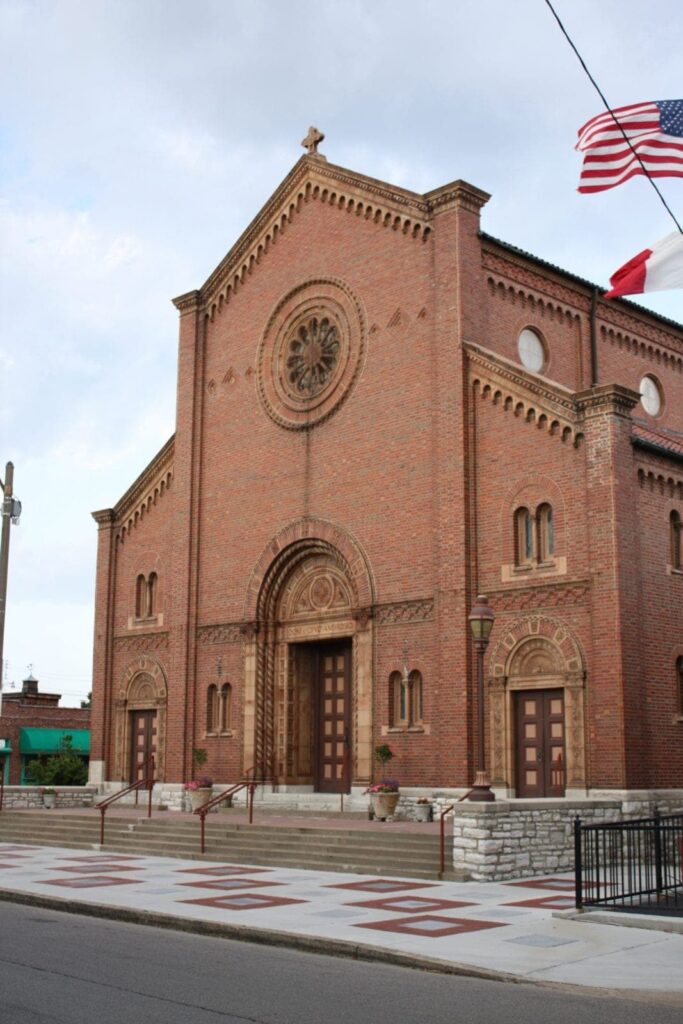
Distance and terrain kept the settlement somewhat apart from the rest of the city, so residents built what they needed close to home: mutual-aid societies, St. Ambrose parish in 1903, an Italian-language newspaper a year later, and a web of groceries, bakeries and shops. That self-reliance shaped the close-knit neighborhood that still stands on The Hill today.
Moments that shaped the neighborhood
-
1850s
Fire clay builds an industry
German and Irish workers mine the area's fire-clay deposits. Evens and Howard opens its clay works in 1854–55 and William Christy starts Laclede-Christy mines in 1857; over a dozen brick and tile plants follow.
Read the story -
1880s
Italian immigrants arrive
Italians begin arriving to work the clay mines, first from villages in Lombardy, many around Cuggiono, and later from Sicily. Men often came first and sent for families; by the 1920s Italians were the largest group.
Read the story -
1902
Volpi begins making salami
John Volpi, an immigrant from Milan, begins producing dried salami and cured meats on Daggett Avenue. The company still operates from its original Hill location.
Read the story -
1903
St. Ambrose mission founded
An Italian mission begins, and a frame church is dedicated on August 3, 1903, at Cooper Street (today's Marconi Avenue) and Wilson Avenue.
Read the story -
1904
Il Pensiero begins publishing
Il Pensiero, an Italian-language newspaper that covers The Hill and St. Louis's Italian community, begins publishing. It is still active.
Read the story -
1906–1907
Parish school and full parish
St. Ambrose Parochial School opens in 1906 in a two-room frame building on Cooper Street. On June 1, 1907, the mission becomes its own parish under Rev. Luciano Carotti.
Read the story -
1918
Gioia's opens as a grocery
Gioia's, founded as a grocery by an immigrant from Marcallo, Italy, opens on Macklind Avenue. Known for its hot salami, it was named a James Beard America's Classic in 2017.
Read the story -
1921–1922
Fire destroys first church
The original wooden St. Ambrose church burns down. Parishioners pledge $1 a month for five years toward a new brick church.
Read the story -
1924
Missouri Baking Co. opens
Northern Italian baker Stefano Gambaro founds Missouri Baking Co., first as a wholesale bread bakery. His family still runs it, now in its third generation.
Read the story -
1926
New St. Ambrose dedicated
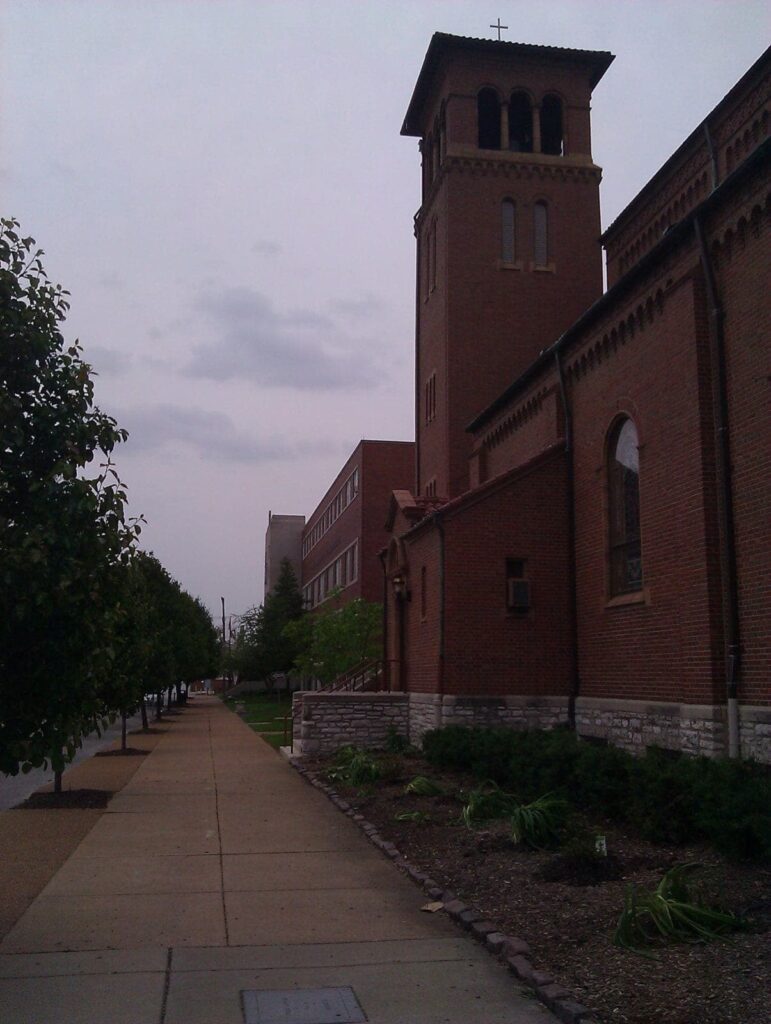
After its cornerstone is laid on May 30, 1925, the Lombard Romanesque church, modeled on Milan's Sant'Ambrogio and designed by Angelo Corrubia, is dedicated on June 27, 1926.
Read the story -
1920s
YMCA clubs organize Hill sports
YMCA staff member Joe Causino organizes neighborhood boys into athletic clubs such as the Fawns, Stags and Ravens. These clubs help produce The Hill's later baseball and soccer stars.
Read the story -
1929
The Big Club buys its hall
The 'Big Club,' an Italian men's social club known for cards, bocce and beer, buys the building at the southwest corner of Shaw and Marconi. It keeps the hall until 1994.
Read the story -
1940s
Toasted ravioli is born
Several Hill restaurants claim to have invented toasted ravioli in the 1940s, chiefly Oldani's (later Mama's on the Hill) and Angelo's (later Charlie Gitto's). The usual story is a cook who accidentally dropped ravioli into hot oil.
Read the story -
1941–1945
The Hill goes to war
According to the Hill neighborhood association, more than 1,020 men from The Hill served in World War II and 23 did not return. Their names are on a bronze plaque at St. Ambrose and a column in Piazza Imo.
Read the story -
1942
Berra and Garagiola sign on
Childhood neighbors on Elizabeth Avenue, Joe Garagiola signs with the Cardinals after a 1942 tryout, and Yogi Berra signs with the Yankees that October. Both become major-league catchers.
Read the story -
1950
World Cup upset of England
On June 29, 1950, in Belo Horizonte, Brazil, the U.S. beats England 1–0. Most accounts say four of the five St. Louisans on the team came from The Hill, including Frank Borghi, Charlie Colombo and Gino Pariani.
Read the story -
1955
St. Ambrose becomes territorial parish
St. Ambrose changes from a national parish for Italians to a territorial parish serving everyone living within The Hill's boundaries.
Read the story -
1965
Park renamed for Midge Berra
The city park bought in 1945 as Virgo Park is renamed Berra Park in November 1965, honoring the late Louis G. 'Midge' Berra, a longtime political force in the area.
Read the story -
c. 1970
Hill 2000 takes shape
Led by Father (later Monsignor) Salvatore Polizzi of St. Ambrose, residents form the nonprofit Hill 2000 to fight blight, keep families in the neighborhood and lead its revival.
Read the story -
1971
I-44 cuts through The Hill
Construction of Interstate 44 demolishes about 100 homes and cuts off the neighborhood's northern edge. Residents raise $50,000 to win an extra overpass, the Edwards Street bridge, that reconnects the two sides.
Read the story -
1972
'The Italian Immigrants' statue
Sculptor Rudolph Torrini's bronze of an immigrant couple, a man with a suitcase and a woman holding a baby, is placed beside St. Ambrose. It is owned by the Hill 2000 association.
Read the story -
1974
Tricolor hydrants make TIME
TIME magazine profiles The Hill's revival, noting that students had painted the neighborhood's fire hydrants and trash cans red, white and green. It reports a population of about 6,500.
Read the story -
1986
First Giro della Montagna
Lifelong resident Joe Torrisi starts the Giro della Montagna bicycle race on The Hill's streets. In 1998 it becomes a cornerstone of the Gateway Cup race series.
Read the story -
2003
Hall of Fame Place dedicated
On June 1, 2003, the 5400 block of Elizabeth Avenue is renamed Hall of Fame Place. It honors Yogi Berra, Joe Garagiola and broadcaster Jack Buck, who lived on The Hill in the late 1950s.
Read the story -
2018
Piazza Imo breaks ground
Ground is broken in June 2018 on Piazza Imo, a privately funded Italian-style plaza across from St. Ambrose with a marble fountain from Italy, granite walkways and gardens.
Read the story -
2023
Msgr. Sal Polizzi dies
Monsignor Salvatore Polizzi, who founded Hill 2000 and created Hill Day while at St. Ambrose, dies on April 24, 2023, at age 92.
Read the story -
2025
Viviano's closes on Shaw
Viviano's, founded in 1950 as John Viviano Sr.'s small cheese shop and at 5139 Shaw Avenue since 1979, closes in spring 2025. The DiGregorio family buys the building.
Read the story -
2025
World Cup mural unveiled
On June 24, 2025, the 75th anniversary of the win over England, St. Louis City SC unveils a mural on The Hill of the five St. Louisans from the 1950 U.S. World Cup team.
Read the story -
Today
A living tradition
Family restaurants, bakeries and markets, St. Ambrose, Berra Park and the red, white and green hydrants still draw visitors from across the region.
Explore the directory
Sources: City of St. Louis, Southampton Neighborhood Association, Hill 2000, Northern Illinois University, Legnano News, St. Louis Media History Foundation, St. Ambrose Parish, Wikipedia, Wikipedia, NextSTL, City of St. Louis, La Voce di New York, Wikipedia, Riverfront Times, TheSTL, Riverfront Times, City of St. Louis, St. Louis Magazine, Wikipedia, SABR, MLB.com, Sports Illustrated (AP), Wikipedia, Wikipedia, City of St. Louis, TIME, St. Louis Review, Regional Arts Commission, Duke Migration Memorials, Terrain, St. Louis Public Radio, City of St. Louis, Riverfront Times, KSDK, KSDK, St. Louis Magazine, St. Louis Public Radio.
Hydrants, bocce and toasted ravioli
Some of The Hill’s traditions are hard to miss: fire hydrants painted in the colors of the Italian flag, bocce courts behind neighborhood taverns, and St. Louis’ own toasted ravioli, a local favorite with deep roots in the neighborhood.
Read history stories